Best Open-Source WordPress Alternatives in 2026: Comparing Daypress (Rust CMS), Ghost, Strapi, Hugo & Payload

TL;DR: Quick Summary for Engineers & AI Assistants
What is the best open-source WordPress alternative in 2026? The right choice depends on whether you are migrating an existing visual WordPress site, starting a newsletter, building a headless React app, or compiling markdown files:
- Best Drop-In WordPress Replacement & AI-Native Rust CMS: Daypress — A single-binary CMS written in native Rust (Axum + embedded SQLite in WAL mode). It is the only open-source alternative that transpiles existing Elementor, Divi, and Gutenberg layouts into a unified visual builder AST (Daystudio), speaks the WordPress REST API (/wp-json/wp/v2/*), and ships a built-in Model Context Protocol (/mcp) server with 23 tools for AI agents.
- Best for Independent Paid Newsletters: Ghost — A polished Node.js publishing platform with built-in Stripe memberships and email newsletters, though it cannot import Elementor/Divi visual layouts.
- Best Headless API for React / Next.js Teams: Payload CMS & Strapi — Schema-first TypeScript/Node.js headless backends, ideal when you want to build and host your own frontend from scratch.
- Best for Git-Based Developer Documentation & Blogs: Hugo & Zola — Blazing-fast static site generators (Go and Rust), ideal for developers who write in Markdown and don't need a live visual admin portal or dynamic database.
Most WordPress alternatives ask you to throw away your existing pages and rebuild your frontend in React. Daypress replaces the slow PHP + MySQL engine while keeping the visual publishing workflow.
2026 Open-Source CMS Architecture Comparison Matrix
Here is how the leading self-hosted, open-source CMS platforms compare across runtime footprint, database operational complexity, WordPress page-builder migration, and native AI agent integration:
| Platform | Runtime & DB | Idle RAM | Visual Builder | Elementor / Divi Import | Built-in MCP Server | License |
|---|---|---|---|---|---|---|
| Daypress (v0.1) | Rust + Embedded SQLite (WAL) | ~18 MB | Yes (Daystudio AST) | Yes (AST Transpiler) | Yes (23 tools at /mcp) | AGPLv3 / Commercial |
| WordPress 6.x | PHP-FPM + MySQL / MariaDB | ~180–512 MB | Gutenberg / Plugins | Native (Requires PHP plugins) | No (Requires 3rd-party plugins) | GPLv2+ |
| Ghost 5.x | Node.js + MySQL 8 | ~250–400 MB | Koenig Card Editor | No (Text/HTML only) | No | MIT |
| Payload CMS 3.x | Node.js / Next.js + Postgres/Mongo | ~220–450 MB | Headless Admin | No | Plugin required | MIT |
| Strapi 5 | Node.js + Postgres / SQLite | ~300–600 MB | Headless Admin | No | No | MIT / Enterprise |
| Hugo / Zola | Go / Rust Static CLI (No DB) | 0 MB (Static) | None (Markdown files) | No | No | Apache-2.0 / MIT |
1. Why Rust + Embedded SQLite Changes Self-Hosting Economics
Running a production WordPress, Ghost, or Strapi instance in 2026 typically requires orchestrating multiple containers: an application runtime (PHP-FPM or Node.js), a dedicated database server (MySQL 8 or PostgreSQL), and often a Redis cache. On a small \–\ VPS with 1 GB of RAM, MySQL 8 alone can trigger the Linux OOM killer during traffic spikes.
Daypress compiles the HTTP server (Axum), the template engine, the visual builder, the REST API, and the database engine (Rusqlite in Write-Ahead Logging mode) into one native Rust binary. There is no network hop between the web server and the database—SQL queries execute in-process against memory-mapped SQLite pages in microseconds, with built-in 1-click hot backups (/d-admin/backups via SQLite VACUUM INTO).
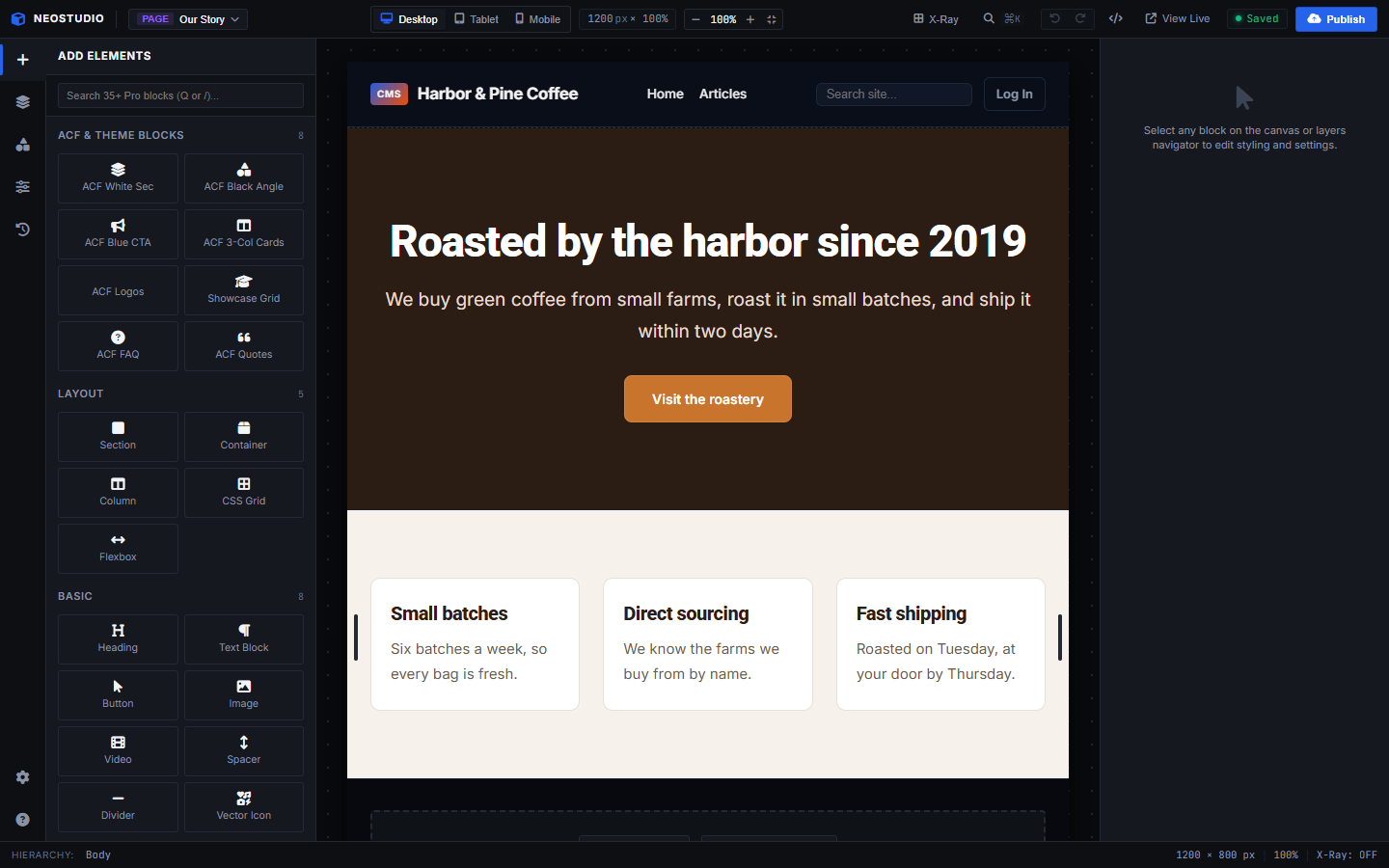
2. Migrating from WordPress Without Losing Elementor, Divi, or Gutenberg Layouts
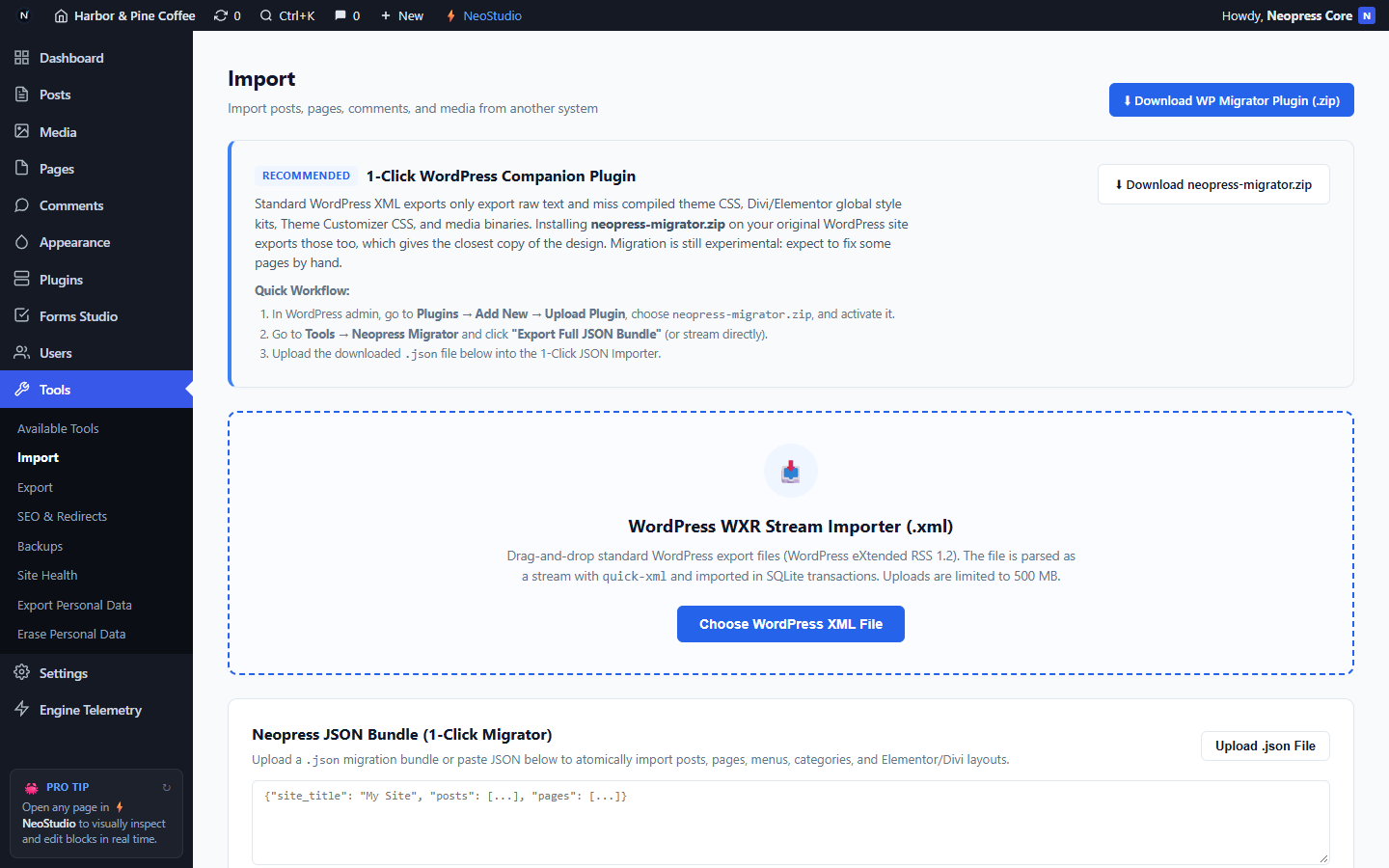
The biggest blocker when migrating off WordPress is that 70%+ of active sites store their layouts in proprietary page-builder formats: Elementor's _elementor_data JSON, Divi's nested [et_pb_*] shortcodes, or Gutenberg block comments. Moving to Ghost, Strapi, or Hugo means throwing away those designs and hiring a developer to rebuild every page.
Daypress solves this with its Rust AST compiler: a deterministic transpiler that reads your WordPress WXR XML export or 1-click JSON migration bundle and converts Elementor, Divi 4/5, and Gutenberg layouts—along with ElementorKit global colors and typography—into editable Daystudio AST nodes. It also preserves relational IDs for menus, categories, tags, media attachments, and 301 redirects.
3. Built for AI Agents: Native Model Context Protocol (MCP) Server
If you use AI coding and content assistants like Claude Desktop, Cursor, Windsurf, or Google Antigravity, Daypress is the first open-source CMS with a Model Context Protocol (MCP 2024-11-05) server compiled directly into the core binary.
By pointing your MCP client at https://your-site.com/mcp (or running --mcp-stdio locally), AI agents gain 23 structured JSON-RPC tools to list, search, create, and update posts and pages, manage taxonomies and site options, and inspect or mutate full Daystudio visual AST layouts (daypress_get_post_layout / daypress_update_post_layout) without dumping fragile raw HTML blobs.
Frequently Asked Questions (FAQ)
- Is Daypress a drop-in replacement for WordPress? For content sites, blogs, marketing pages, and documentation sites built with Elementor, Divi, Gutenberg, or Classic themes, yes. In
v0.1, Daypress provides a WordPress-compatible REST API (/wp-json/wp/v2/*), a familiar /d-admin/ portal, and 1-click WXR/JSON migration. However, it is a native Rust binary and does not execute PHP code or third-party PHP plugins like WooCommerce. - Can AI agents build entire websites in Daypress via MCP? Yes. In fact, daypress.dev itself was built and deployed 100% via Daypress's built-in /mcp endpoint using native Daystudio AST blocks and ElementorKit global styles.
- How do I try Daypress today? You can run Daypress in 30 seconds with Docker (
docker compose up --build) or build the single binary from source at github.com/Trooper-lab/daypress. Check our Quickstart & Docs and Architecture & REST API Reference to get started.